
Run your institution as an intelligence
How a credit union coordinates work when the Knowledge Fabric holds the context and people hold the judgment.
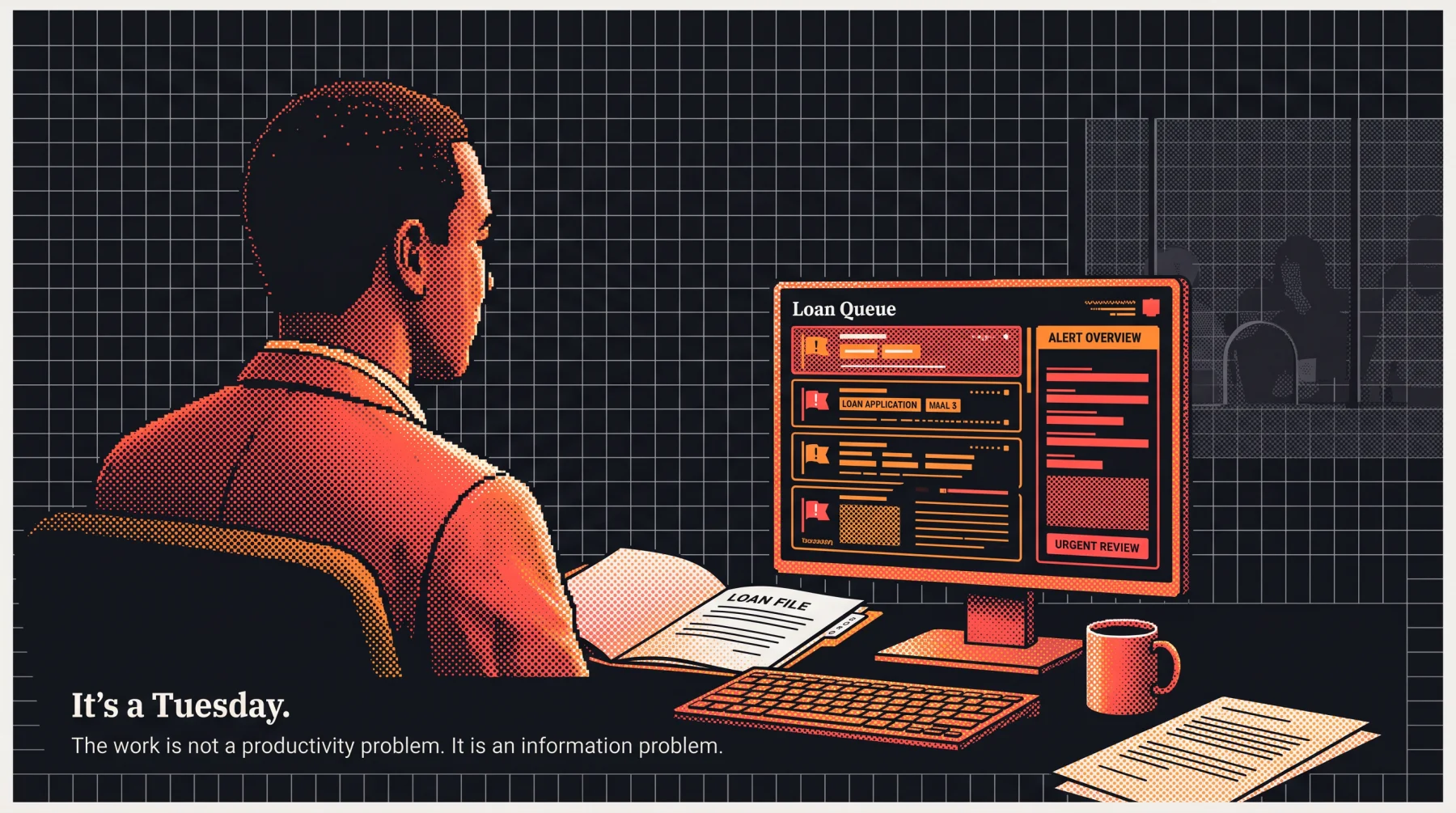
Your BSA officer is days behind on alert dispositions. A member's loan file has sat a week on one missing document. Collections is working off a spreadsheet, and the examiner is due, with half the answers living in one person's memory.
None of it is a productivity problem. It is an information problem.
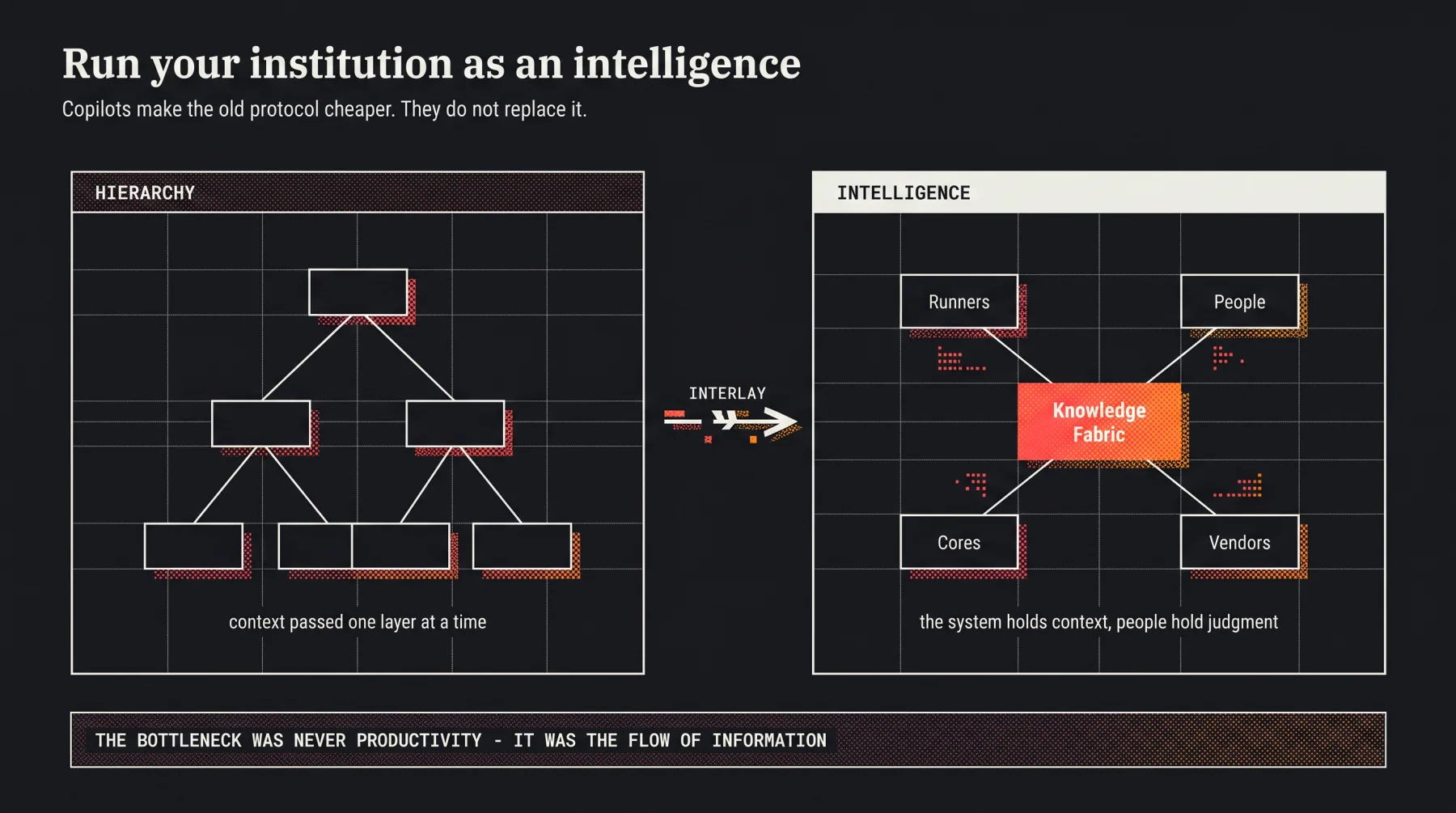
That is all a hierarchy ever solved. Span of control, staff vs line, the railroad org chart: they existed because a human could only hold so much context and pass it one layer at a time. Copilots make that protocol cheaper. They do not replace it.
Runline Framework rebuilds the institution around that fact. Company OS is what it becomes once it is running yours: the same stack, shaped to your Runlines, your Runners, and your people.
The Framework replaces what the hierarchy did with Interlay: become the connective tissue between the systems you already run, and accelerate the flow of information to the humans and agents who need it. Circuit moves the facts. The Fabric holds the picture. The Grid authorizes every agent action. Runners compose the work. Employees stay in the work, more of it, at higher leverage.
We are not here to replace your people. We are here to make the credit union 100× more capable.
The bottleneck was never productivity. It was the flow of information.
Order of operations
Automating first is the expensive bug. Question the requirement (a person's name, not "Compliance"). Delete the step. Simplify. Speed the generate → verify loop. Automate last: that last step is a Runner on a Workstream, not a chatbot in a sidebar.
Plain English is now how you specify the work. A Workstream is the container: an SOP written as code, or a looser project. It holds Items, the nouns of the domain: Loans, Tasks, Contracts, Alerts. Every Item is versioned, evaluated, cited, and traced through the Grid. Skip that and you have a model bolted onto a guess, the kind of demo that falls apart in an exam.
Partial autonomy. Every Workstream has an autonomy slider (complete the sentence, rewrite the file, run the case) set tight enough that the person on the Workstream will actually trust it. It amplifies the human at the controls. It is not an unsupervised bot turned loose on member data.
Four things the Framework produces
Not a product roadmap. Four outputs. Failure to compose one of them is the backlog.
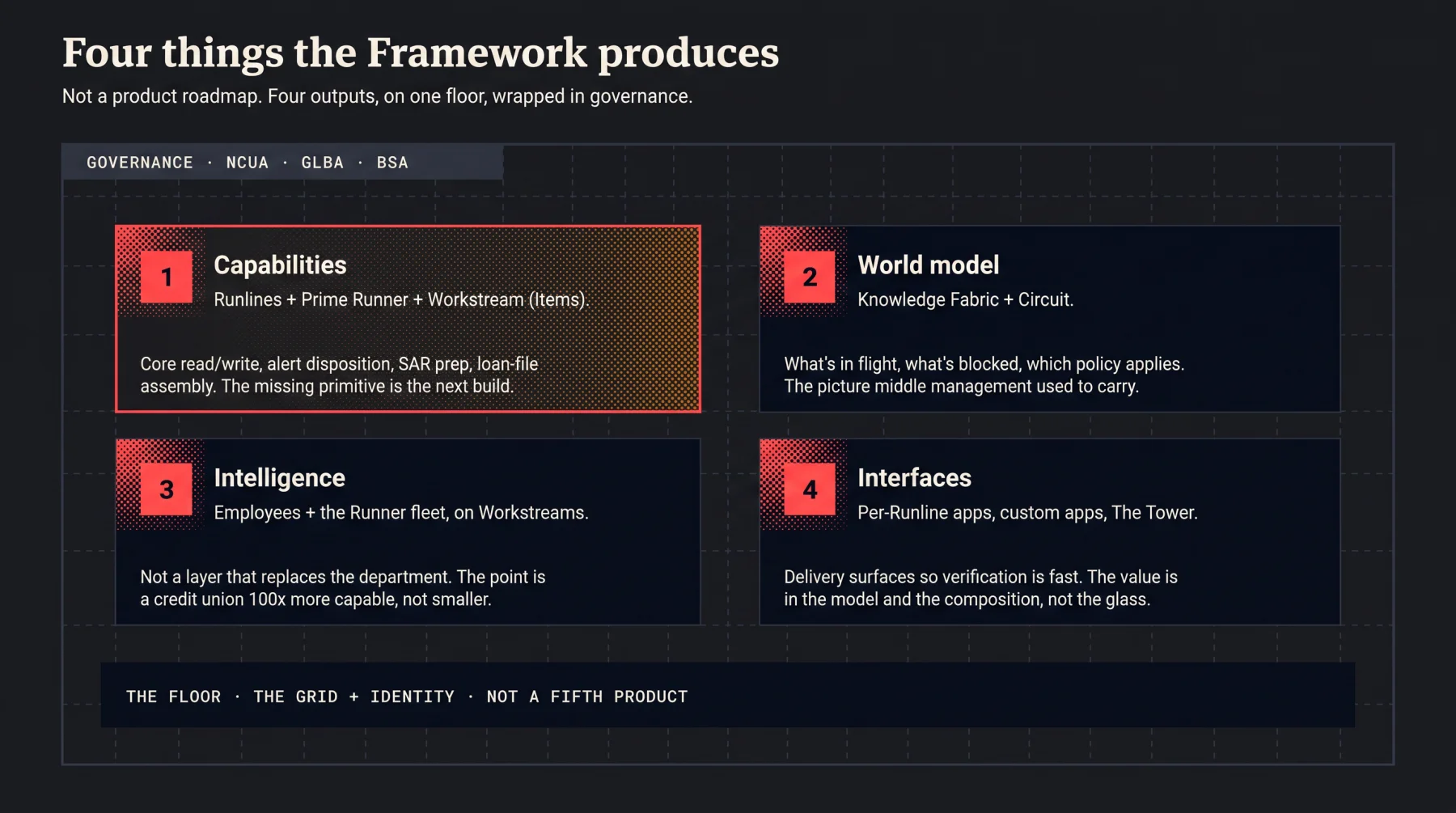
Capabilities
A Runline is a governed workflow service for one domain: state, approval gates, audit, sync. It ships a Prime Runner, the durable, named agent for that domain at that CU, and it ships an interface: the web app the team actually opens. Primitives underneath: core read/write, alert disposition, SAR (suspicious activity report) prep, loan-file assembly, vendor access. Reliability, permission, Grid audit. If the Prime Runner cannot compose a solution, the missing primitive is the next build.
Build them for two users: staff and agents. An API the model cannot tool is unfinished. Your team can also build custom apps on the same primitives when a Runline's shipped UI is not the view they need.
World model
Company side: what's in flight, what's blocked, which policy applies, who touched it, what the examiner will ask. Member side: drafts, delinquencies, wires, SARs, not surveys. Circuit is the nervous system (real-time event / CDC, change data capture). Knowledge Fabric is the intelligence foundation (normalized cross-core schemas, cited retrieval). This is the picture middle management used to carry. Interlay is how it touches the cores, the LOS (loan origination system), the BSA (Bank Secrecy Act) platform, the shared drive, without pretending they go away.
Intelligence
Intelligence is not a layer that replaces the department. It is your people and the Runner fleet, on the same Workstreams. A Runner executes Items; a human reviews, redirects, approves, and takes the calls the model should not make. Seasonal cash that starts to look like structuring → Fabric context + Workstream + prior dispositions → draft tracker, park the 5% for the person who owns the queue. The Prime Runner is the one that lives; the fleet around it is ephemeral. The employee is not a fallback. They are the point of the 100×.
Interfaces
Each Runline ships with its web app. The Tower is the cross-cutting command surface: Runner activity, cost, audit. You can compose personal views on the primitives when the default app is the wrong lens. Delivery surfaces exist so verification is fast. Value is not in the glass. Value is in the Fabric and the composition.
The Grid and Identity are the floor, not a fifth product. Org-scoped OIDC (OpenID Connect). Auth, rate limits, kill-switch, audit on every agent hop. One control plane into cores and vendors.
Data · Agents & Workflows · Interfaces · Security · Lexicon
People in the loop, not above it
The platform gives you Runner (executes Items) and Runline (the governed lane). The human on that lane reviews, redirects, approves. They are not a safety comment on an autonomous bot. They are half of the intelligence.
- ICs (individual contributors) own a layer (Fabric, Circuit, Grid, a Runline, a custom app) and decide without a status meeting.
- DRIs (directly responsible individuals) own a problem for a season and can pull any layer. A requirement without a name is a department talking.
- Player-coaches still build. They grow craft. They do not ferry context.
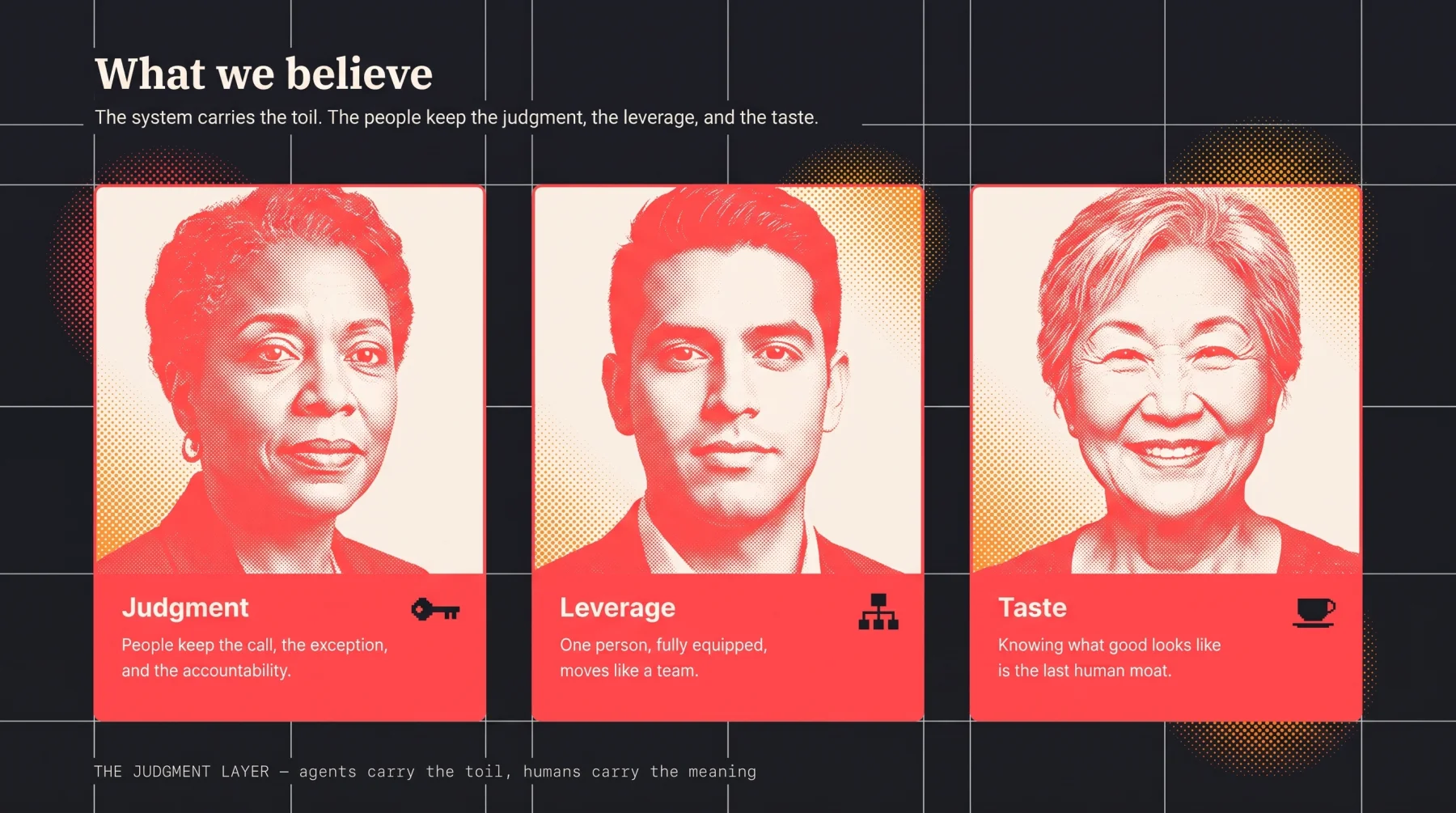
Agents carry toil. People keep calls, exceptions, accountability, member relationships. Taste does not outsource. The slider is theirs. The 100× is what happens when the same headcount can clear the queue, sit with the member, and still have a Saturday.
Why this is a vendor swap, not a reorg
The thinking here is not ours alone. Karpathy frames the next decade as the decade of agents, built on tight verify loops and autonomy sliders, not AGI theater. Musk's rule: do not automate the step you should have deleted. Dorsey names the same four outputs, capabilities, a world model, an intelligence layer, and interfaces. Interlay is how we implement it: do not rip out the core, become the connective tissue between it and everything else. And distribution is the outsourcing wedge:
Your CUSO already does the work. The board already approved the line. Swap the vendor. The Prime Runner never sleeps, never forgets, and every hop hits the Grid for the examiner.
Vendor swap beats reorg. That is delete-without-firing.
The Framework stands up in a week. Teaching the institution the why, and not to automate the step that should have been deleted, is the work. (Adoption playbook.)
If the institution understands nothing hard, AI is a cost story. If it does, Company OS does not decorate the credit union.
It is the credit union, made executable: humans and Runners, same Workstreams, faster information.
Your Company OS, wired
Governance wraps it. Inside that band the Framework becomes Company OS:
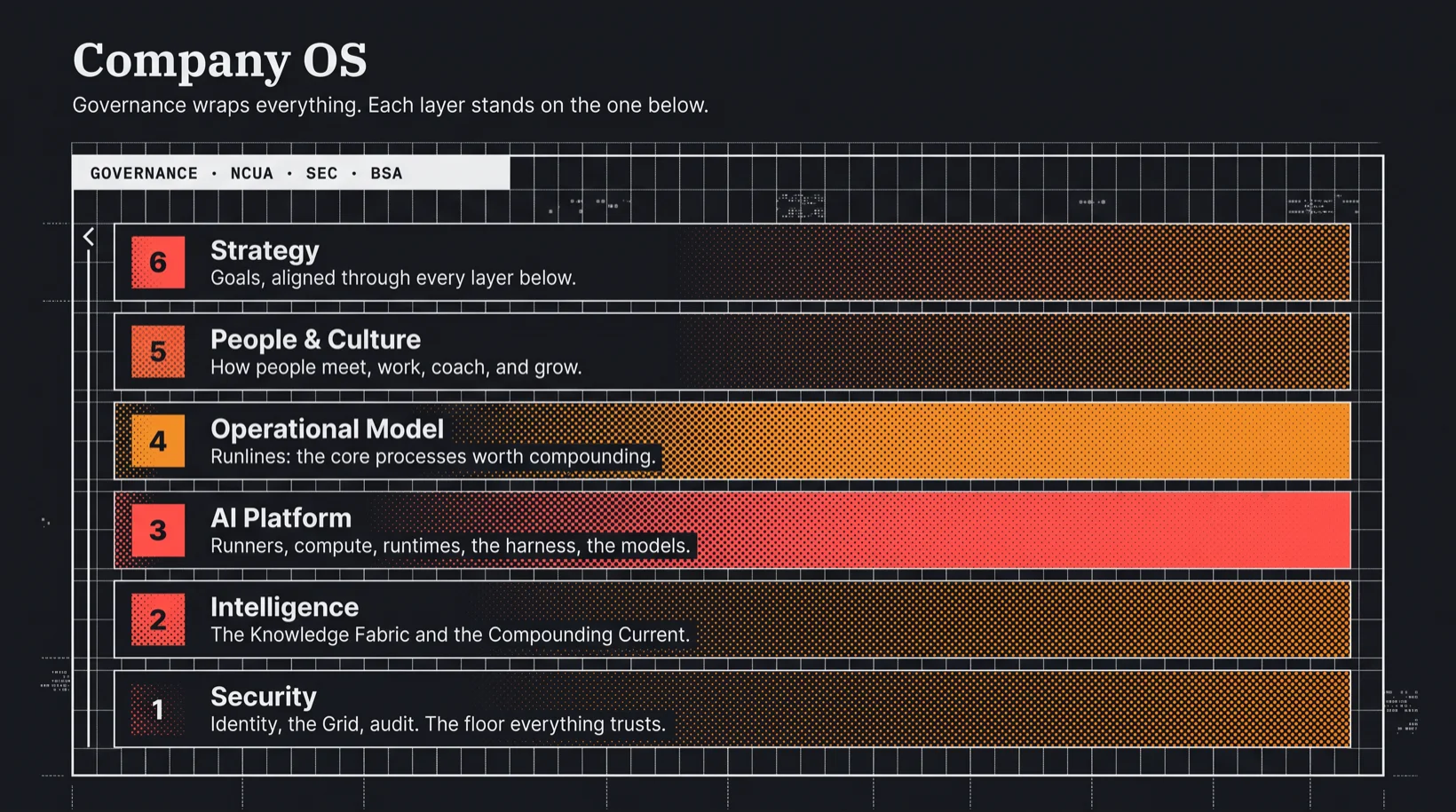
| Layer | What runs |
|---|---|
| Floor | Identity, The Grid |
| Intelligence | Circuit, Knowledge Fabric, Compounding Loop |
| Platform | Runner fleet, Workstreams / Items, harness |
| Operating model | Runlines that survived deletion, each with its app, slider, and human gate |
| People | Employees on the Workstream. The verify half of the loop. The 100×. |
| Strategy | Goals wired through the layers. Compose-failure is the roadmap. |