
Data · Knowledge Fabric
The intelligence foundation: CDC pipelines, normalized schemas, semantic search.
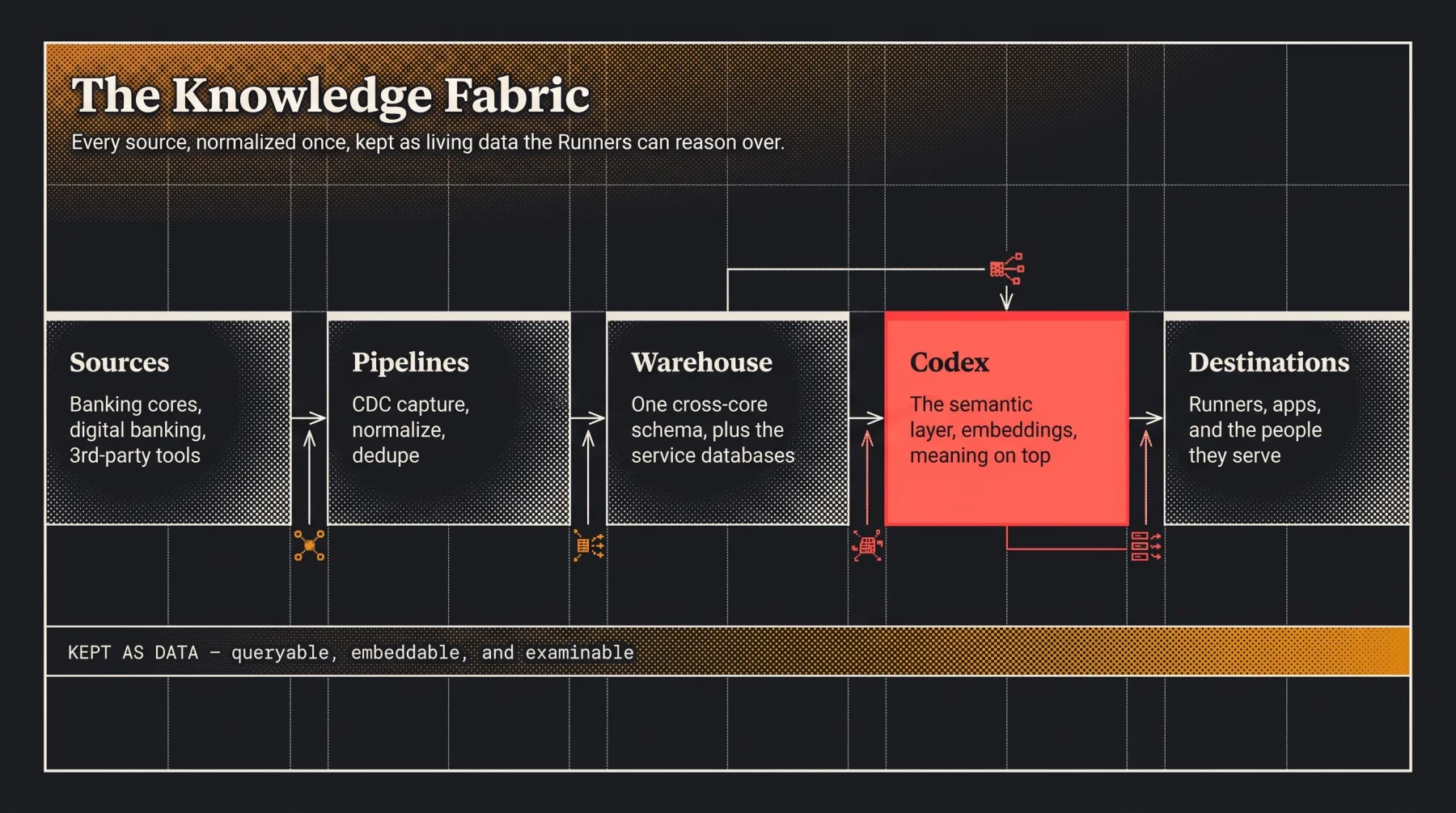
The Knowledge Fabric is what makes Runners effective. It ingests and structures a credit union's SOPs, policies, compliance rules, and operational data into retrieval-ready context.
What's in it
- Change Data Capture (CDC) pipelines from banking cores, data flows out of legacy cores continuously, not by batch export.
- Normalized cross-core schemas: a single shape over cores (CU*Answers, Corelation, and more) that have never spoken the same language.
- Vector-indexed semantic search: provenance-backed retrieval across systems, so a Runner can cite where an answer came from.
This is the moat
Deep, core-processor-specific data work takes months per core and requires understanding established architectures. It's the hardest thing to copy and the most valuable thing a Runner stands on.
How it connects
The nervous system that moves this data is Circuit, the org-wide event/CDC layer. The retrieval intelligence built on top is the semantic layer. Runners in the Agent Runtime query the Fabric; everything they read is auditable through The Grid.
Pipelines
Pipelines are the CDC flows that pull data out of banking cores and land it, continuously rather than by batch export. They feed both the warehouse and the semantic layer: CDC from CU*BASE / Symitar / Corelation into the warehouse, plus per-client ingest jobs.
Warehouse
Each credit union gets an analytical warehouse (e.g. ClickHouse over a Symitar core, with per-CU pipelines), normalized so Runners query one shape across cores that never spoke the same language.
Databases
Operational databases back the services and Runlines: Neon Postgres per service and (per ADR-013) per-CU where isolation requires it, plus the vector index (LanceDB) for semantic retrieval.
Destinations
Destinations are the systems ingested data lands in and is served from: warehouses, operational databases, and the vector index, each with provenance so a Runner can cite its source.
Codex
Codex is Runline's knowledge-fabric service: the API that backs each client's knowledge base, with provenance-backed retrieval so a Runner can always cite where an answer came from.
Learn more
- Circuit: the real-time layer that keeps the Fabric current
- Security · The Grid: how every read is authorized and audited