Workflows · Runlines
Governed workflow services for a domain: state, approval gates, audit, and a Prime Runner.
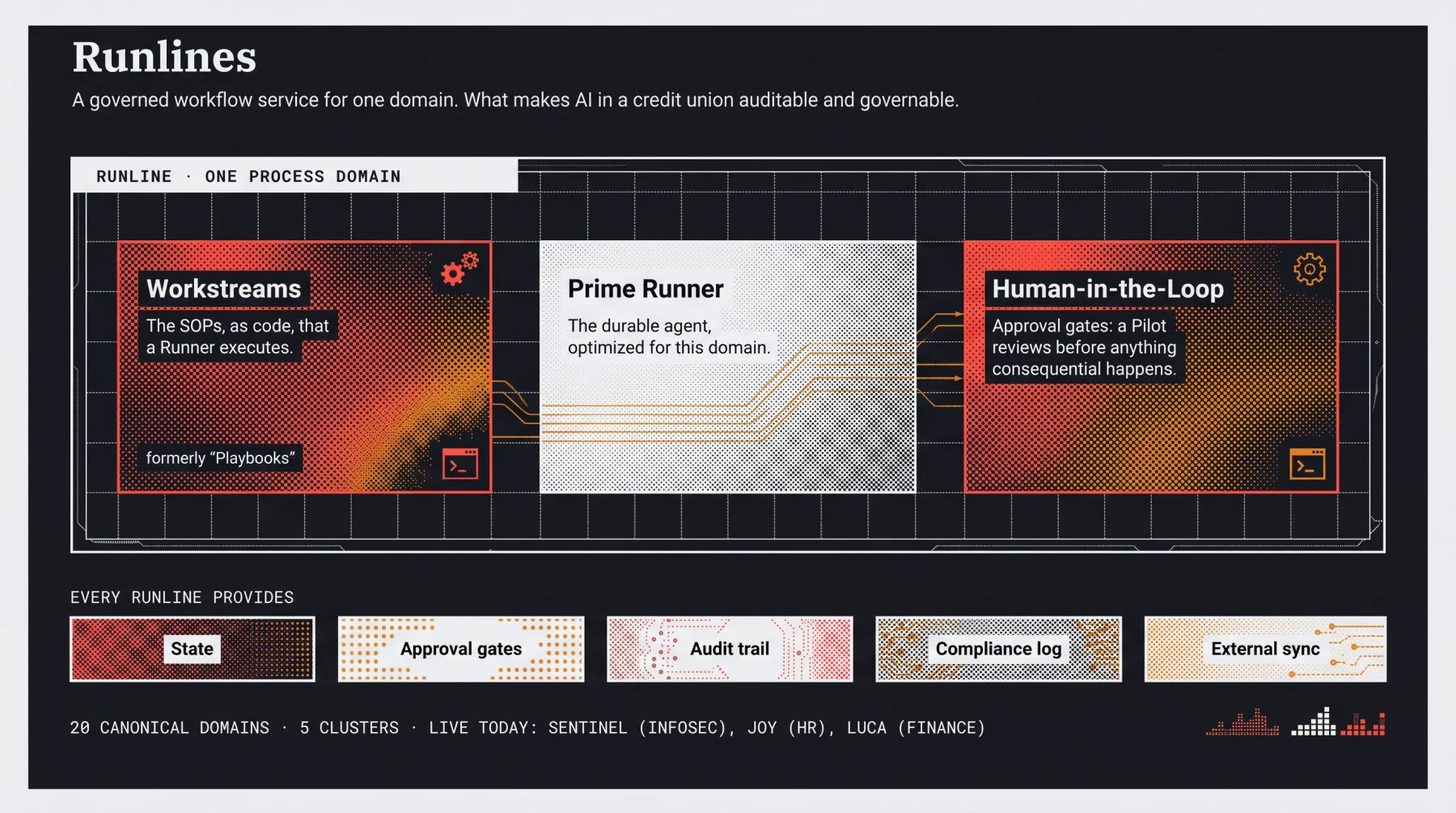
A Runline is a governed workflow service for a single process domain (InfoSec, Lending, HR, BSA…). Every Runline provides state management, human approval gates, an audit trail, compliance logging, and external-system sync. Runlines are what make AI work in a credit union auditable and governable. Each ships a Prime Runner optimized for that domain.
What's inside a Runline
- Workstreams: the SOPs, as code, that a Runner executes. (Formerly "Playbooks".)
- Human-in-the-Loop: the approval gates where the human on the Workstream reviews and approves before anything consequential happens.
- A Prime Runner: the durable agent for the domain (see Agents · Runners).
Workstreams
A Workstream is a standard operating procedure expressed as code: the concrete steps, checks, and gates a Runner follows inside a Runline. (Workstreams are what we used to call Playbooks, same concept, renamed once we built the primitive.)
- Runline Workstreams: canonical process knowledge owned by the Runline; applies to any Runner in that domain.
- Runner Workstreams: specialized knowledge a specific Runner developed for edge cases; may graduate to a Runline Workstream if it generalizes.
Every Workstream is built audit-first: staged writes and approval gates before the automation, so the work is governable in a regulated institution.
Human-in-the-Loop
Human-in-the-Loop (HITL) is the gate model at the heart of gated autonomy: a Runner has full capability, but the human on the Workstream approves at the specific points where a mistake would be expensive or hard to reverse. The three tiers are allow / ask / block; gates are defined in a Workstream; review happens on the Console, Arc, or email.
The catalog
The library is organized around 20 canonical CU domains across 5 clusters, tracked in the Catalog & Domains. Live and in build today: InfoSec, HR, and Finance, with Lending in active development.