
Start
Governance-First
Compliance embedded in the architecture, not bolted on. Built for NCUA examination from day one.
Compliance is not a feature we add. It is the foundation we build on. Runline is built for NCUA examination from day one, and human oversight is enforced by the architecture, not by policy: the system cannot file a SAR or post a journal entry without a human approval on the record.
Built for the examiners
NCUAPart 748
FFIECexam-aligned
BSA / AMLSAR-ready
FinCENCTR / SAR
OFACsanctions
GLBASafeguards
FCRAcredit data
SOC 2audit-ready
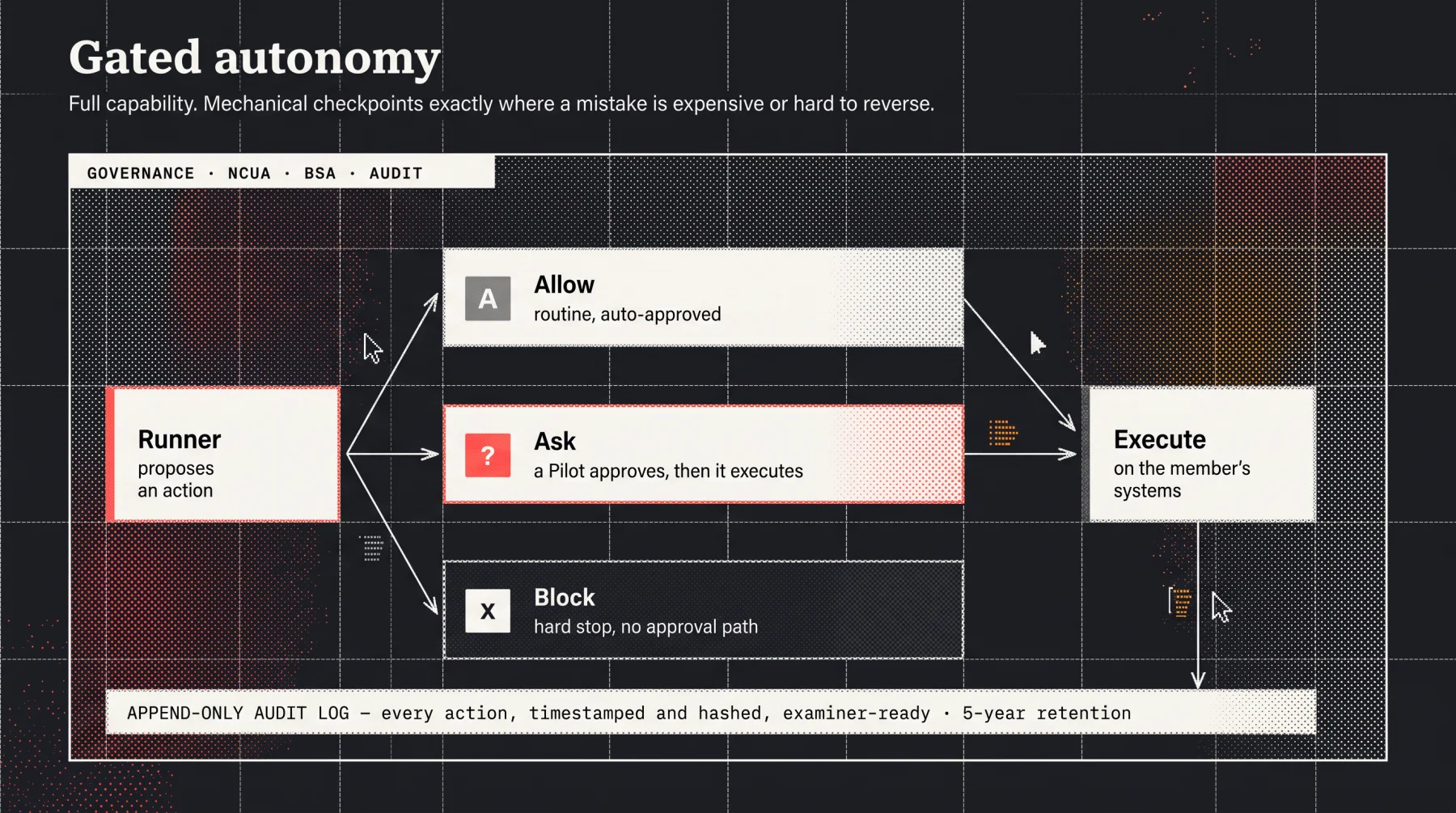
Gated autonomy
A Runner keeps full capability, with mechanical checkpoints at the exact points where a mistake would be expensive or hard to reverse. Three tiers, never two:
- Allow: routine, auto-approved.
- Ask: needs a human's approval, and can still execute once approved.
- Block: a hard stop, no approval path, surviving even elevated autonomy.
What NCUA requires, and how we answer it
| NCUA requirement | Runline's architecture response |
|---|---|
| Human oversight of AI decisions | Approval gates on every consequential action. No autonomous action on critical paths. |
| Immediate shutdown of AI systems | The kill-switch: sub-100ms, per-key and per-agent, behind 2FA. |
| Audit trail for AI-assisted work | Append-only, immutable, timestamped events. Examiner-ready export, 5-year retention. |
| Risk-management documentation | SOPs codified as Workstreams and Skills: versioned, auditable, examinable. |
| Vendor oversight | The Grid centralizes every AI vendor connection, with unique keys per vendor and per agent. |
| Member-data handling | Member data hashed in audit logs. No persistent member data in model context. |
Learn more
- Examiner Center: the frameworks, the shared-responsibility split, and what the examiner actually sees
- Security & the Grid: the control plane and tenant isolation in depth
- Who we serve, and why: where the liability sits, and why governance is not advisory